Showing posts with label seized dogs. Show all posts

Wednesday, 21 December 2022

Welfare of Seized Dogs


Appoint an Independent Team to oversee the welfare of dogs seized by Police - Please sign and share the Petition


Debbie Connolly is an experienced behaviourist & expert witness assessor for Dangerous Dogs Act cases and started this petition:

Dogs seized by Police are held in kennels whilst cases are investigated. Owners cannot be told where these kennels are located.  I am an expert witness, I assess dogs involved in bite incidents.  Some forces allow us to see the dog at the holding kennels, many forces do not or have changed their policies to prevent us visiting dogs in kennels.

I have personally made complaints to Police and RSPCA regarding unsuitable conditions, there are many incidents in the papers where dogs have died during seizure or gone home in a very poor state.  These have not made much difference.

I wrote a charter to improve the seized dog process, starting with leaving contact details with the owner and particularly allowing experts to assess all dogs at the kennels. The big names in the dog industry, Dogs Trust, Blue Cross, Battersea, Kennel Club etc do not wish to support this and wish to carry on with their work.  Whilst they do this, after years of them achieving no change, dogs are suffering. I intend to bring this change now.

Only the allowing of experts into kennels and the appointing of an independent inspection team can change the welfare state of seized dogs. 

Please sign and share https://www.change.org/welfareofseizeddogs

Thursday, 30 September 2021

BSL Petition Update-Committee calls on Government to respond

Please sign here: Exempt dogs assessed by experts as safe from breed specific legislation - Petitions (parliament.uk)

The Petitions Committee has decided not to schedule a debate on this petition, however, the petitions committee has now requested the Government respond to new questions as below:

The Committee recognises the support that the petition has received. However, the issue raised by the petition was recently debated in the House of Commons on 5 July in response to a petition making a related request.

Given the significant support for petitions about prohibitions for certain dog types, the Committee has written to the Secretary of State for Environment, Food and Rural Affairs, highlighting support for petitions on this subject.

The Committee has called on the Government to:

- Establish a new framework for responsible ownership of dog types which are currently prohibited under the Dangerous Dogs Act
- Commission new research to consider the evidence base for current prohibitions
- Look at alternatives to current prohibitions on certain dog types

In the letter, the Committee has said the Government should publish the outcome of this work, followed by a Government review of the prohibitions set out in the Dangerous Dogs Act.

You can read the Committee's letter here: https://committees.parliament.uk/publications/7403/documents/77570/default/

The Committee will publish the Government's response when it is received, and notify petitioners by email.

Saturday, 31 July 2021

DDA-BSL UK - further calls for total overhaul - the Vet Times:

 The Dangerous Dogs Act (DDA) has been slammed in a damning new report as animal welfare charities and the BVA renew calls for an urgent review of the controversial legislation.

With the 30th anniversary of the act looming in August, the RSPCA has released a report titled “Breed specific legislation – a dog’s dinner” that blames laws surrounding supposedly dangerous breeds for harming dogs and dog owners.

Ineffective

The law was introduced in 1991 as a reaction to a period of highly publicised dog attacks which culminated in a law that the report admonishes as backed by “a surprising lack of scientific evidence”.

The report finds that while the DDA introduced a raft of measures intended to decrease the amount of dog bite incidents across the UK, it has in no way impacted the rate of such attacks.

Increased cases

Between March 2005 and February 2015, the number of hospital admissions in England due to dog bites increased 76% – from 4,110 to 7,227.

Samantha Grimes, an RSPCA dog welfare expert and lead author of the report, described the DDA as “letting down” dogs that look a certain way before going on to describe the DDA as “unfair, unjust and wrong”.

Fatalities

Dr Grimes added: “The Dangerous Dogs Act was a knee-jerk piece of legislation, introduced in response to a series of high-profile dog attacks.

“But in the 30 years since its inception, hospital admissions due to dog bites have continued to rise, tragic fatalities as a result of dog incidents have continued, and thousands of dogs have needlessly lost their lives.

“It’s high time the UK Government responds to the scientific research, follows in the footsteps of other nations around the world that have repealed breed-specific legislation and do not just what is right for dogs, but for public safety, and ensure both are better protected.”

Section one

The BVA has long called for a total overhaul of the law as part of its “Deed not Breed” campaign that urges the Government to consider new legislation that examines severity of incidents rather than the breed involved.

The association would rather see section one of the act – pertaining to specific banned breeds – removed entirely and an Australian-style database of known dog bites to be set up.

‘Total overhaul’

BVA senior vice-president Daniella Dos Santos said: “We have long campaigned for a total overhaul of the 1991 DDA because it targets specific breeds rather than deeds and gives a false impression that dogs not on the banned list are ‘safe’.

“Evidence gathered as part of our recent policy update further supports our view that breed-specific legislation has been ineffective in its intended aims, thereby failing to properly protect the public or safeguard dog welfare over the past three decades.”

Dr Dos Santos added: “We’ll be writing to the Home Office and Defra, and will be joining up with other campaign organisations in the lead-up to the act’s 30th anniversary in August to push for effective, evidence-based solutions.”

  • For the full story, see the 6 July issue of Vet Times.

Friday, 18 May 2018

DDA/BSL Consultation Opens

EFRA Committee Information

An inquiry into the Dangerous Dogs Act and breed specific legislation is now open for written evidence.
The Environment, Food and Rural Affairs Committee is launching an inquiry into the legislation on dangerous dogs.
The Dangerous Dogs Act 1991 was introduced to protect the public from dangerous dog attacks. The Act made it an offence to keep four types of dog traditionally bred for fighting - the pit bull terrier, Japanese Tosa, Fila Brasileiro and Dogo Argentino - unless the dog was placed on the Index of Exempted Dogs and kept in compliance with certain requirements.
There has been substantial debate about the effectiveness of this legislation and the impacts on dog welfare. According to the RSPCA, 30 people died between 1991 and 2016 in dog-related incidents, of which 21 involved dogs of breeds/types not prohibited by the law. The number of attacks has also risen, with yearly hospital admissions for dog bites increasing by 76% between 2006-2016.
Neil Parish MP, Chair of the Environment, Food and Rural Affairs Committee, said:
“The Government is responsible for protecting the public from dangerous animals, so it is essential that laws evolve alongside our understanding of what works.
“The 1991 Dangerous Dogs Act banned four specific types of dog, but since then attacks have continued and 21 people have been killed by non-banned types.
 “My Committee will investigate whether the Government's current approach is having the desired effect, and whether any changes are needed to ensure that the public is properly protected and that animal welfare concerns are properly addressed”.  
Terms of reference
  1. How effective is the Government’s current approach to protecting the public from dangerous dog attacks?
  2. What changes, if any, should be made to the current approach and legislation?
  3. How can local authorities and police forces be best supported in reducing the number of dangerous dog-related incidents?
  4. What lessons could the UK learn from other countries dealing with similar issues?

Deadline for submissions


Written evidence should be submitted through the Committee’s web portal by midnight on Wednesday 6 June. It is recommended that all submitters familiarise themselves with the Guidance on giving evidence to a Select Committee of the House of Commons which outlines particulars of word count, format, document size, and content restrictions.

Friday, 11 March 2016

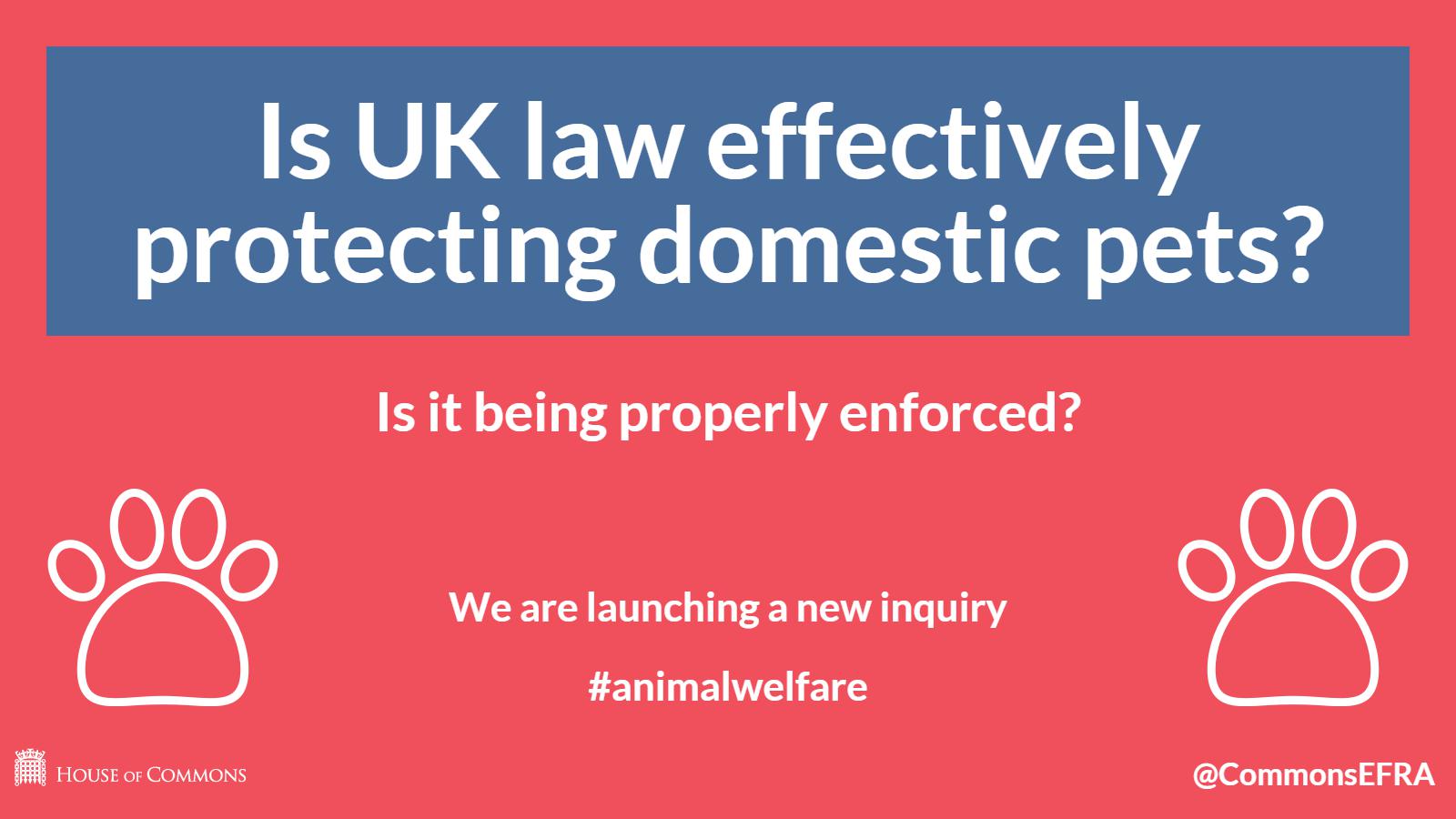
EFRA Inquiry on Animal Welfare:

The Environment, Food and Rural Affairs Sub-Committee will be holding a series of short inquiries on animal welfare over the course of this Parliament.
The first inquiry will focus on domestic pets, including cats, dogs and horses. The Committee will consider issues surrounding exotic pets at a later date.
In the UK, about 1 in 2 households own a pet with around 21 million pets owned (excluding fish). The UK pet population is estimated at nine million dogs, approximately 8 million cats. The Animal Welfare Act places a legal obligation on owners and keepers of animals to care for them properly.
The inquiry will examine the effectiveness of the Act and its enforcement with regards to domestic animals.
The inquiry will also examine whether that Act and other existing legislation remains fit for purpose in the age of the internet with regards to the sale of domestic pets.
The proposed terms for inquiry are:
  • The effectiveness of the Animal Welfare Act 2006 with regard to domestic pets;
  • Regulation surrounding the sale of domestic pets, including online sales and advertising;
  • Enforcement of current animal welfare legislation, including prosecution of offences by the police, local authorities, the RSPCA and others:
  • Comparative approaches to enforcement in England, Northern Ireland, Scotland and Wales.

The Committee asks for written submissions by noon on Thursday 17 March. Written submissions should be made via the Animal welfare: domestic pets inquiry page on the Environment, Food and Rural Affairs website.
As a guideline submissions should state clearly who the submission is from e.g. ‘Written evidence submitted by xxxx’ and be no longer than 1500 words, please contact the Committee staff if you wish to discuss this.
Submissions must be a self-contained memorandum in Word or Rich Text Format (not pdfs). Paragraphs should be numbered for ease of reference, and the document should, if possible, include an executive summary.
Submissions should be original work, not previously published or circulated elsewhere. Once submitted, your submission becomes the property of the Committee and no public use should be made of it unless you have first obtained permission from the Clerk of the Committee. Please bear in mind that Committees are not able to investigate individual cases.
The Committee normally, though not always, chooses to publish the written evidence it receives, either by publishing it on the internet or by making it publicly available through the Parliamentary Archives. If there is any information you believe to be sensitive you should highlight it and explain what harm you believe would result from its disclosure; the Committee will take this into account in deciding whether to publish or further disclose the evidence.
The personal information you supply will be processed in accordance with the provisions of the Data Protection Act 1998 for the purposes of attributing the evidence you submit and contacting you as necessary in connection with its processing. The Clerk of the House of Commons is the data controller for the purposes of the Act.