Showing posts with label EFRA. Show all posts

Thursday, 30 March 2023

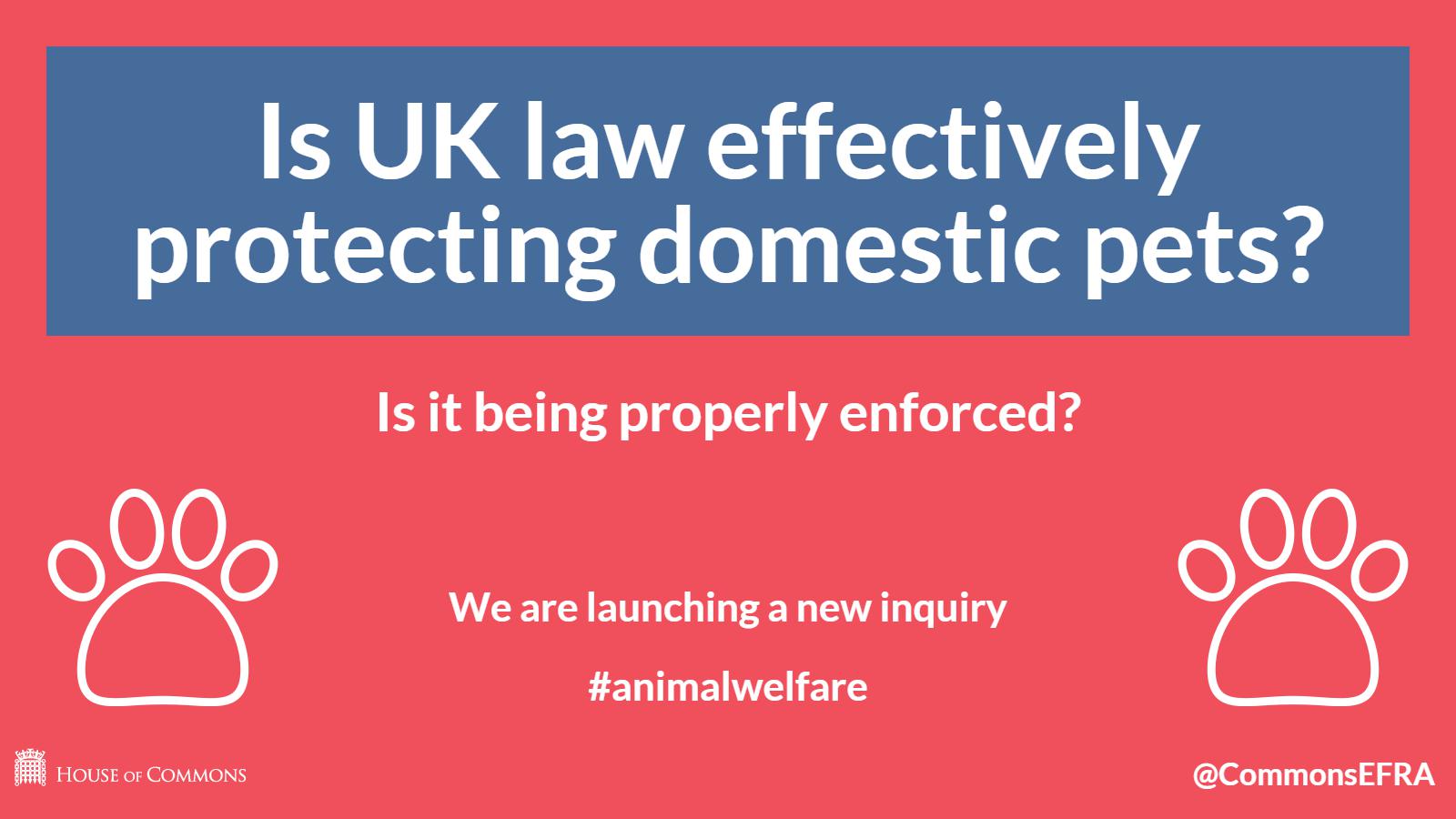
EFRA Committee-Pet Welfare Inquiry

 The deadline for the EFRA Committee call for evidence on Pet Welfare and Abuse in England has been extended to 14 April 2023

You can submit your views on pets and companion animals and read the full terms of reference online here:  https://committees.parliament.uk/call-for-evidence/3043/

While there are many responsible pet breeders and loving owners, there are, unfortunately, some serious exceptions to the rule.

In particular, unscrupulous breeders, including criminals, sought to exploit the increased demand for pets during the pandemic. 

Other issues include the rise of “designer pets”, that result in dogs having genetic deformities. These are often due to unregulated canine fertility clinics. There continue to be concerns about illegal mutilation practices, such as the ear cropping of dogs and the de-clawing of cats.

Separately, some who acquired a pet during the pandemic are finding that they are unfortunately no longer able to fully care for their pets as home working opportunities decrease, and the cost of pet care and living more generally increase.

All this is raising serious concerns about animal welfare, and leading to increased pressure on vets and pet charities.

Terms of reference

The Committee invites submissions on the following:

Unscrupulous breeding and importation:

1. What risks to biosecurity and public health are posed by abhorrent practices such as unscrupulous breeding, including “puppy mills” – which are characterised by poor conditions and rapid breeding – both here and those overseas from which dogs are then imported, often in large numbers in a single vehicle,

the importation of dogs, including heavily pregnant bitches, and cats, and “rescue dogs” (some of whom are misrepresented as such);

as well as similar practices for other species of companion animals? Is the occurrence of such activities changing?

2. What risks do unregulated and illegal Canine Fertility Clinics present to dog welfare, including the breeding of so-called “designer” dogs? What is the appropriate role and regulation of assisted breeding techniques in dog breeding?

Abuse and mutilation:

3. Is the ban on mutilation – such as ear cropping (or docking) of dogs, and de-clawing in cats – under the Animal Welfare Act 2006 effective? How prevalent are practices such as illegal ear cropping, and the importation of dogs whose ears have been cropped overseas or cats that have been de-clawed (which remains legal)?

Ownership and animal welfare:

4. There was a marked increase in pet ownership during the pandemic. What is the situation for companion animals’ welfare post-pandemic, especially given recent factors such as

a. adverse changes in the cost of living?

b. a decrease in home working?

5. What are the pressures currently facing those dealing with companion animal welfare including

a. the veterinary sector?

b. the charitable animal welfare sector?

Current preventative measures:

6. Is the current regulatory and legal framework to both support the welfare and prevent the abuse of companion animals fit for purpose? Do the available penalties – and the probability of prosecution – act as a sufficient deterrent?

7. Will the Animal Welfare (Kept Animals) Bill (as currently drafted) take a significant step to tackling poor pet welfare and abuse, including those issues stated above?

8. What additional measures should the Government take to stop bad practices, improve overall domestic pet welfare, and assist those involved in supporting domestic pet welfare?

A “companion animal” is usually defined as a domestic pet, including cats, dogs and horses, for example. This inquiry is focused on pet welfare in England, although horses may be included as they have been impacted in the pandemic, in terms of homing/caring issues, as well as other companion animals.


Friday, 18 May 2018

DDA/BSL Consultation Opens

EFRA Committee Information

An inquiry into the Dangerous Dogs Act and breed specific legislation is now open for written evidence.
The Environment, Food and Rural Affairs Committee is launching an inquiry into the legislation on dangerous dogs.
The Dangerous Dogs Act 1991 was introduced to protect the public from dangerous dog attacks. The Act made it an offence to keep four types of dog traditionally bred for fighting - the pit bull terrier, Japanese Tosa, Fila Brasileiro and Dogo Argentino - unless the dog was placed on the Index of Exempted Dogs and kept in compliance with certain requirements.
There has been substantial debate about the effectiveness of this legislation and the impacts on dog welfare. According to the RSPCA, 30 people died between 1991 and 2016 in dog-related incidents, of which 21 involved dogs of breeds/types not prohibited by the law. The number of attacks has also risen, with yearly hospital admissions for dog bites increasing by 76% between 2006-2016.
Neil Parish MP, Chair of the Environment, Food and Rural Affairs Committee, said:
“The Government is responsible for protecting the public from dangerous animals, so it is essential that laws evolve alongside our understanding of what works.
“The 1991 Dangerous Dogs Act banned four specific types of dog, but since then attacks have continued and 21 people have been killed by non-banned types.
 “My Committee will investigate whether the Government's current approach is having the desired effect, and whether any changes are needed to ensure that the public is properly protected and that animal welfare concerns are properly addressed”.  
Terms of reference
  1. How effective is the Government’s current approach to protecting the public from dangerous dog attacks?
  2. What changes, if any, should be made to the current approach and legislation?
  3. How can local authorities and police forces be best supported in reducing the number of dangerous dog-related incidents?
  4. What lessons could the UK learn from other countries dealing with similar issues?

Deadline for submissions


Written evidence should be submitted through the Committee’s web portal by midnight on Wednesday 6 June. It is recommended that all submitters familiarise themselves with the Guidance on giving evidence to a Select Committee of the House of Commons which outlines particulars of word count, format, document size, and content restrictions.

Friday, 11 March 2016

EFRA Inquiry on Animal Welfare:

The Environment, Food and Rural Affairs Sub-Committee will be holding a series of short inquiries on animal welfare over the course of this Parliament.
The first inquiry will focus on domestic pets, including cats, dogs and horses. The Committee will consider issues surrounding exotic pets at a later date.
In the UK, about 1 in 2 households own a pet with around 21 million pets owned (excluding fish). The UK pet population is estimated at nine million dogs, approximately 8 million cats. The Animal Welfare Act places a legal obligation on owners and keepers of animals to care for them properly.
The inquiry will examine the effectiveness of the Act and its enforcement with regards to domestic animals.
The inquiry will also examine whether that Act and other existing legislation remains fit for purpose in the age of the internet with regards to the sale of domestic pets.
The proposed terms for inquiry are:
  • The effectiveness of the Animal Welfare Act 2006 with regard to domestic pets;
  • Regulation surrounding the sale of domestic pets, including online sales and advertising;
  • Enforcement of current animal welfare legislation, including prosecution of offences by the police, local authorities, the RSPCA and others:
  • Comparative approaches to enforcement in England, Northern Ireland, Scotland and Wales.

The Committee asks for written submissions by noon on Thursday 17 March. Written submissions should be made via the Animal welfare: domestic pets inquiry page on the Environment, Food and Rural Affairs website.
As a guideline submissions should state clearly who the submission is from e.g. ‘Written evidence submitted by xxxx’ and be no longer than 1500 words, please contact the Committee staff if you wish to discuss this.
Submissions must be a self-contained memorandum in Word or Rich Text Format (not pdfs). Paragraphs should be numbered for ease of reference, and the document should, if possible, include an executive summary.
Submissions should be original work, not previously published or circulated elsewhere. Once submitted, your submission becomes the property of the Committee and no public use should be made of it unless you have first obtained permission from the Clerk of the Committee. Please bear in mind that Committees are not able to investigate individual cases.
The Committee normally, though not always, chooses to publish the written evidence it receives, either by publishing it on the internet or by making it publicly available through the Parliamentary Archives. If there is any information you believe to be sensitive you should highlight it and explain what harm you believe would result from its disclosure; the Committee will take this into account in deciding whether to publish or further disclose the evidence.
The personal information you supply will be processed in accordance with the provisions of the Data Protection Act 1998 for the purposes of attributing the evidence you submit and contacting you as necessary in connection with its processing. The Clerk of the House of Commons is the data controller for the purposes of the Act.

Friday, 17 May 2013

Dangerous Dog Act - Amendments Planned


The government has published proposed amendments to the Dangerous Dogs Act 1991 - the amendments are now underway; if passed as law, these amendments will affect not only the prohibited dogs but all breeds and types of dog in England and Wales.
 
The draft Dangerous Dogs (DD) Amendment Bill was recently published by Defra, shortly afterwards the EFRA committee launched a two week inquiry to invite written evidence followed by oral evidence specifically on the proposed Bill; they received 86 written responses.


The draft DD Amendment Bill was expected to be in the Queen’s speech on 8th May (meaning it will be one of several bills addressed in the next parliamentary session), but, it was not.

The proposed changes had appeared, without explanation within the Anti-Social Behaviour, Crime and Policing (ASCP) Bill which is a Home Office bill and was included in the Queen’s speech; on the government’s legislative agenda - it is now underway to become an Act – new legislation, which is far reaching, for all dogs and their owners.

The planned amendments to the DDA were published in the ASCP bill before EFRA had published its written report on the evidence it received. Previously the Home Affairs Committee had held an inquiry into this bill ending in January but this was before the amendments from the draft DDA bill were placed into this bill.

So in a nutshell;

·         an Inquiry ending in January 2013 was previously held into the ASCP Bill but at the time the DDA Amendments were not included in the bill

·         a draft Dangerous Dogs Amendment Bill was published by Defra on 9th April

·         a separate inquiry was held by the EFRA Committee - with a deadline of 22nd April

·         the Queen’s speech on 8th May included the ASCP Bill

·         the Government went ahead and placed the amendments within the ASCP Bill which was published on the 9th May

·         the EFRA committee published its report on 16th May on the pre-legislative inquiry it just held but the Amendments were already published

The ASCP Bill is now in progress – this is a large detailed bill where a relatively small portion relates to dogs - it could easily slip past undetected unless you were actually looking for it.

To follow the progress of the Bill click here - you will see that the second reading is due in the Commons on the 10th June 2013

You can read the Bill online here - Part 7 - specifically relates to ‘Dangerous Dogs’ – keeping dogs under proper control and whether a dog is a danger to public safety.

The text from the original draft DDA Amendment Bill has been changed as it’s moved from bill to bill – in reference to the ‘Householder defence’ – there is no longer the need for the owner to be present at the time of an incident in a building that is a dwelling (ie your home) - but this defence applies to the building only, not the garden etc. So presumably if a burglar is in your garden and your dog injures him or there are reasonable grounds your dog might - you are on the wrong side of the law.


The Anti-Social Behaviour, Crime & Policing Bill also contains the new provisions of Public Spaces Protection Orders and Community Protection Notices are also included in this Bill.

Currently we have Dog Control Orders which are to be repealed and replaced with Public Spaces Protection Orders. PSPO's – these will also be made by local authorities but not parish councils. There’s no limit to what a PSPO can command and they can remain for up to three years.

Community Protection Notice (CPN) will be issued by the police and local authorities, this is a new power for when there is ‘conduct of a persistent or continuing nature’. The CPN specify requirements to do specified things, cease doing specified things or to take reasonable steps to achieve specified results.


Friday, 19 April 2013

EFRA Committee Update


Environment, Food and Rural Affairs Committee
Select Committee Announcement - 18 April 2013

Evidence session: DRAFT DANGEROUS DOGS (AMENDMENT) BILL

On 9 April Defra published draft legislation aimed at tackling dangerous dogs. The Environment Food and Rural Affairs Committee will hear oral evidence as part of its pre-legislative scrutiny of these proposals on Wednesday 24 April from 3 pm.

The witnesses will be:
At 3.00 pm:

 •Gareth Pritchard, Temporary Deputy Chief Constable and

•PC Keith Evans, Association of Chief Police Officers (ACPO)

•Richard Leaman, Chief Executive, Guide Dogs Association

At 3.45 pm:

 •Clarissa Baldwin, CEO, Dogs Trust

•Claire Horton, Chief Executive, Battersea Dogs and Cats Home

•Steve Goody, Director of External Affairs, Blue Cross

•RSPCA

The meeting will take place in committee room 15 at the Palace of Westminster.
Further information on the inquiry is available on the Committee’s website.

****************************************************

FURTHER INFORMATION:

The Government’ proposed legislation Draft Dangerous Dogs (Amendment) Bill, Cm 8601,  is at http://www.official-documents.gov.uk/document/cm86/8601/8601.pdf

The Committee’s report published in February 2013, Dog Control and Welfare, HC 575 is at http://www.publications.parliament.uk/pa/cm201213/cmselect/cmenvfru/575/575.pdf and the Government’s response is at http://www.publications.parliament.uk/pa/cm201213/cmselect/cmenvfru/1092/1092.pdf

Defra’s consultation document Promoting more responsible dog ownership is at http://www.defra.gov.uk/consult/2012/04/23/dangerous-dogs-1204/.

Committee Membership is as follows:  Miss Anne McIntosh (Chair), Thomas Docherty, Richard Drax, George Eustice, Barry Gardiner, Mrs Mary Glindon, Ian McKenzie, Sheryll Murray, Margaret Ritchie, Neil Parish, Dan Rogerson

Specific Committee Information: efracom@parliament.uk/ 020 7219 6194/ 020 7219 3262

Committee Contact: Sarah Coe coes@parliament.uk 020 7219 2290  Twitter @CommonsEFRA

Media Information: Hannah Pearce pearcehm@parliament.uk/ 020 7219 8430

Committee Website: www.parliament.uk/efracom              

Watch committees and parliamentary debates online: www.parliamentlive.tv  

Publications / Reports / Reference Material: Copies of all select committee reports are available from the Parliamentary Bookshop (12 Bridge St, Westminster, 020 7219 3890) or the Stationery Office (0845 7023474). Committee reports, press releases, evidence transcripts, Bills; research papers, a directory of MPs, plus Hansard (from 8am daily) and much more, can be found on www.parliament.uk

Wednesday, 10 April 2013

Your Views on Proposed Law Changes Requested

Environment, Food and Rural Affairs Committee
Select Committee Announcement
10 April 2013

MPs TO SCRUTINISE PROPOSED LAW ON DANGEROUS DOGS
EFRA Committee invites written evidence.
On 9 April Defra published draft legislation aimed at tackling dangerous dogs.
 
The Environment Food and Rural Affairs Committee will conduct pre-legislative scrutiny of these proposals and invites interested parties to submit written evidence on the draft clauses and related dog control issues.
 
The Committee published its report Dog Control and Welfare in February 2013 making recommendations on Defra’s 2012 consultation on promoting more responsible dog ownership.The draft clauses published this week take forward those measures upon which the Government is now proposing to legislate.
 
The EFRA Committee would welcome views on the following issues:
 
· Do Defra’s draft clauses translate the Government’s intentions on dog control into clear, proportionate, and effective legislation?
· Do the proposed measures provide a sufficient legislative base to tackle irresponsible dog ownership?
 
o If not, which additional measures should be brought into law?
o Are any of the proposed measures unnecessary or counterproductive?
 
The Committee will focus in this short inquiry on the legislative mechanisms required to tackle dog control.
 
It will take into account the evidence submitted to its previous, wider Dog Control and Welfare inquiry so it is not necessary to resubmit full evidence covering these points. However, interested parties may wish to update any previously submitted evidence in light of the proposed legislation and the Committee’s February report.
 
Interested parties who wish to submit written evidence on these and related matters are invited to do so by Monday 22 April 2013.

****************************************************
 
FURTHER INFORMATION:
Guidance for those wishing to submit written evidence is at:
The Government’ proposed legislationDraft Dangerous Dogs (Amendment) Bill, Cm 8601, is athttp://www.official-documents.gov.uk/document/cm86/8601/8601.pdf
The Committee’s report published in February 2013,Dog Control and Welfare, HC 575 is at http://www.publications.parliament.uk/pa/cm201213/cmselect/cmenvfru/575/575.pdf
Defra’s consultation documentPromoting more responsible dog ownership is at http://www.defra.gov.uk/consult/2012/04/23/dangerous-dogs-1204/.
Committee Membership is as follows: Miss Anne McIntosh (Chair), Thomas Docherty, Richard Drax, George Eustice, Barry Gardiner, Mrs Mary Glindon, Ian McKenzie, Sheryll Murray, Margaret Ritchie, Neil Parish, Dan Rogerson,
Specific Committee Information:efracom@parliament.uk/ 020 7219 6194/ 020 7219 3262
Committee Contact:Sarah Coecoes@parliament.uk020 7219 2290 Twitter @CommonsEFRA
Media Information: Hannah Pearcepearcehm@parliament.uk/ 020 7219 8430
Committee Website:www.parliament.uk/efracom
Watch committees and parliamentary debates online:www.parliamentlive.tv
Publications / Reports / Reference Material: Copies of all select committee reports are available from the Parliamentary Bookshop (12 Bridge St, Westminster, 020 7219 3890) or the Stationery Office (0845 7023474). Committee reports, press releases, evidence transcripts, Bills; research papers, a directory of MPs, plus Hansard (from 8am daily) and much more, can be found on www.parliament.uk