Monday, 11 July 2016

Global End-BSL Rally and Protests


Dog defenders to rally at Westminster in peaceful protest against failed law that targets types of dog – breed specific legislation (BSL).
Peaceful protests have been organised around the world for July 2016 – the Westminster event takes place on the 16th July at Old Palace Yard, Westminster, SW1P 3JY at 1pm to 5pm. Other UK events have been organised for Wales, Northern Ireland, Herefordshire and the South West of England.

Ontario, Quebec, Winnipeg, Victoria, Ottawa Canada and Germany also have protests panned for the same day as part of a global movement to repeal breed specific laws.

The London event is organised by DDA Watch and will mark 25 years of failed legislation – the UK introduced breed specific legislation in the Dangerous Dogs 1991 Act and campaigners say the law continues to cost millions of pounds in taxpayers' money to enforce and does nothing to protect people nor dogs alike, neither does it promote responsible dog ownership.

Thousands of pets continue to be put to death or deemed ‘dangerous’ based on their physical appearance, the law makes no sense, is barbaric and is long overdue for repeal, dogs continue to be ripped apart from their families even though they have never put a paw wrong.

People are coming together, making a stand and speaking out in defence of ALL dogs regardless of what shape or size they happen to be.


Leading animal welfare charities have disagreed with and openly discredited BSL for many years, outlining the fact that dogs cannot be labelled 'dangerous' for their looks alone and they have called for an end to this outdated legislation.

The peaceful protest takes place at Westminster, London UK on the 16th July, event details can be found on the DDAW event page on FB.


Tuesday, 5 April 2016

Dog Microchipping - New Law:

Compulsory dog microchipping comes into force this month - applying to all dogs.

From 6 April 2016 all dogs in England, Scotland and Wales will be legally required to be microchipped and their up-to-date details registered on one of the authorised databases. (Northern Ireland has already introduced this measure.)

From the 6th of April 2016, all dogs must be microchipped and registered to an approved database by the time they are 8 weeks old.
If a keeper of a dog which is not microchipped gets served with a notice requiring them to have the dog chipped, they will have 21 days to do this.
There are no exemptions regarding age. A dog will be legally exempt from being microchipped only when a vet certifies that it cannot be microchipped for health reasons and this needs to done on a form approved by the Secretary of State.
Your dog is considered microchipped when:
~ implanted with a microchip
and
~ the correct details are registered on an approved database. 
If you do not get your dog microchipped or your details registered on an approved database, then it will be considered as not complying with the regulations and a notice may be served. If the keeper does not microchip their dogs within 21 days of the served notice, then you will be liable to pay a fine of £500.
If any dog keeper subsequently moves address, changes contact telephone number, etc. then they must keep their database details up-to-date.  Failure to do so means that enforcement can be taken and a notice served. If the keeper does not get their details up to date within 21 days of the served notice, then you will be liable to pay a fine of £500.


Friday, 11 March 2016

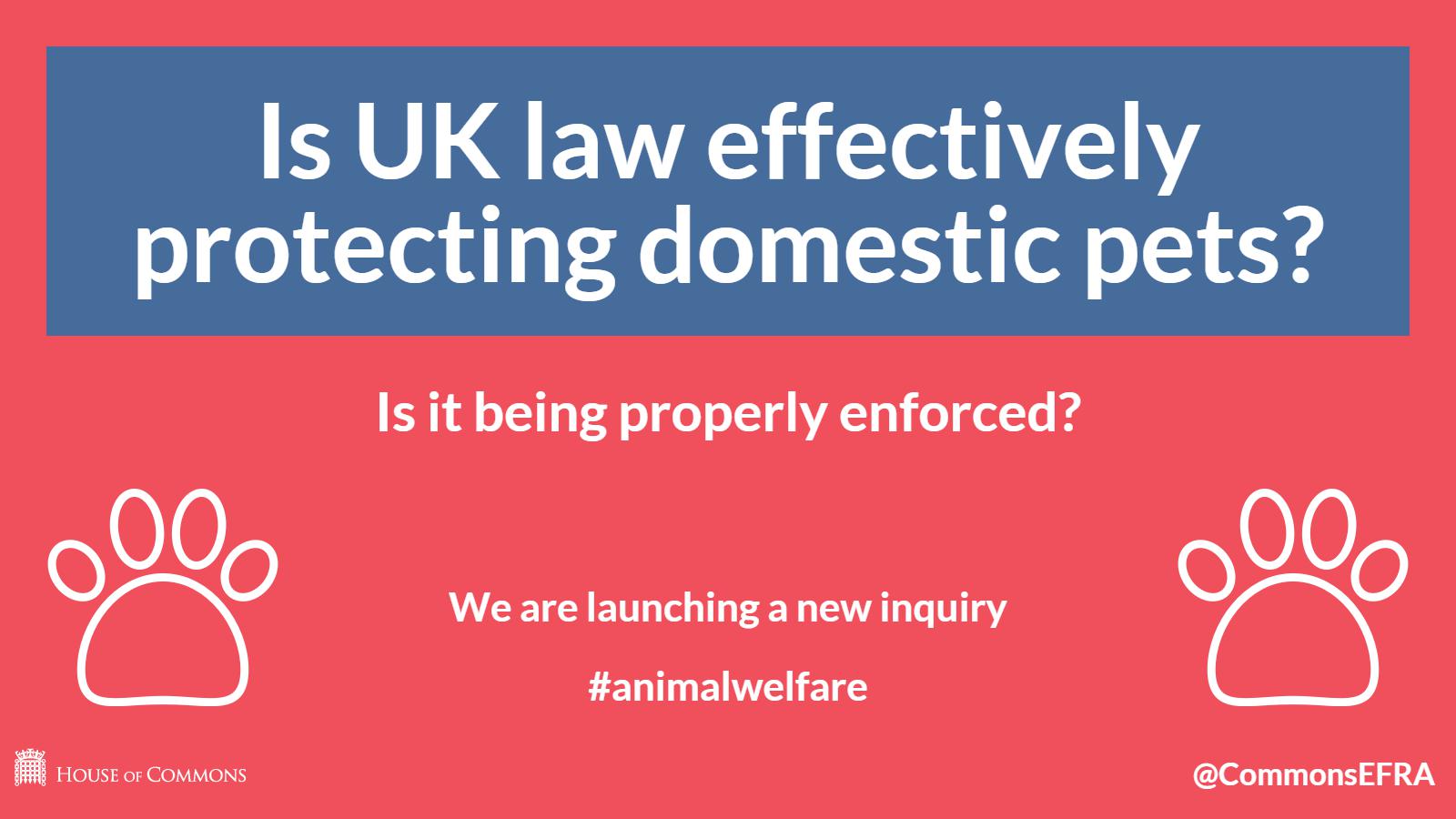
EFRA Inquiry on Animal Welfare:

The Environment, Food and Rural Affairs Sub-Committee will be holding a series of short inquiries on animal welfare over the course of this Parliament.
The first inquiry will focus on domestic pets, including cats, dogs and horses. The Committee will consider issues surrounding exotic pets at a later date.
In the UK, about 1 in 2 households own a pet with around 21 million pets owned (excluding fish). The UK pet population is estimated at nine million dogs, approximately 8 million cats. The Animal Welfare Act places a legal obligation on owners and keepers of animals to care for them properly.
The inquiry will examine the effectiveness of the Act and its enforcement with regards to domestic animals.
The inquiry will also examine whether that Act and other existing legislation remains fit for purpose in the age of the internet with regards to the sale of domestic pets.
The proposed terms for inquiry are:
  • The effectiveness of the Animal Welfare Act 2006 with regard to domestic pets;
  • Regulation surrounding the sale of domestic pets, including online sales and advertising;
  • Enforcement of current animal welfare legislation, including prosecution of offences by the police, local authorities, the RSPCA and others:
  • Comparative approaches to enforcement in England, Northern Ireland, Scotland and Wales.

The Committee asks for written submissions by noon on Thursday 17 March. Written submissions should be made via the Animal welfare: domestic pets inquiry page on the Environment, Food and Rural Affairs website.
As a guideline submissions should state clearly who the submission is from e.g. ‘Written evidence submitted by xxxx’ and be no longer than 1500 words, please contact the Committee staff if you wish to discuss this.
Submissions must be a self-contained memorandum in Word or Rich Text Format (not pdfs). Paragraphs should be numbered for ease of reference, and the document should, if possible, include an executive summary.
Submissions should be original work, not previously published or circulated elsewhere. Once submitted, your submission becomes the property of the Committee and no public use should be made of it unless you have first obtained permission from the Clerk of the Committee. Please bear in mind that Committees are not able to investigate individual cases.
The Committee normally, though not always, chooses to publish the written evidence it receives, either by publishing it on the internet or by making it publicly available through the Parliamentary Archives. If there is any information you believe to be sensitive you should highlight it and explain what harm you believe would result from its disclosure; the Committee will take this into account in deciding whether to publish or further disclose the evidence.
The personal information you supply will be processed in accordance with the provisions of the Data Protection Act 1998 for the purposes of attributing the evidence you submit and contacting you as necessary in connection with its processing. The Clerk of the House of Commons is the data controller for the purposes of the Act.

Wednesday, 12 August 2015

24th Anniversary of Failed BSL in the UK:

Today, the 12th August 2015, marks twenty four years of the draconian Dangerous Dogs Act 1991 and within it deeply flawed breed specific legislation which has caused untold misery and heartbreak for the past twenty four years.

The Act is simply put, not fit for purpose, it does nothing to promote or achieve a safer environment for people and dogs alike, write to your member of parliament and let them know your thoughts-the only way to bring about legislative change is within the House of Commons and it's long overdue.

It is about time we in the UK moved forward and consigned this outdated and senseless piece of law into the bin.

Remembered today and always~
  are all the victims of man's failed legislation and the betrayal of our canine companions.


Monday, 23 February 2015

DDA Amendments 2015-Draconian Measures On The Way:

An Act designed to promote the death of innocent dogs, is changed again and man's best friend is once again attacked in another totally pointless piece of legislation.

The breed specific part of the Dangerous Dogs Act 1991, as amended, is set to be amended once again – the changes will come into force on Tuesday 3rd March 2015.

The changes, are contained within a piece of law called a Statutory Instrument (SI 2015 Number 138) which was unknown to the majority, until it appeared online, having been put before parliament on the 10th and 11th of February by Lord de Mauley.

The Order doesn't require any vote or debate yet introduces far reaching consequences for those who care for exempted dogs and those who are subject to section 1 of the legislation (BSL) in England and Wales.

Included in the Order are the following changes:

~ The conditions which are attached to the exemption certificate, issued by the Index of Exempted Dogs have been revised, there are some changes including the following:

The need for a dog to be tattooed as part of the exemption process will no longer be a requirement, a positive for those unfortunate to be caught up under BSL.

The implantation of the microchip as part of the exemption process is restricted to certain people and access to the exempted dog must be given for the chip to be read by an authorised person. Also, proof of insurance can be requested and five days is given to provide this.

There is a new legal requirement that the exempted dog must be kept at the same address as the person to whom the exemption certificate has been issued save for any 30 days over a 12-month period and to notify the Agency (the Index) of any proposed change of address (not to include any changes of address in the 30 days mentioned above). This new requirement is expected to cause not only confusion but serious problems for those who may for example be away on work for over 30 days a year or away visiting relatives/friends/overseas etc.

~ Ownership and Keepership of Exempted Dogs:

There is major change in that the transfer of keepership for exempted dog will only be possible if the appointed person is either dead or seriously ill and then an application must be made to the court and the police notified. 
Those who need to re-home their exempted dog due to for example housing issues will no longer be able to appoint a new keeper-not unless they are seriously ill (or die)-then an application can be made to the court and the court must look at whether the proposed keeper is a 'fit and proper' person, the temperament and past behaviour of the dog and any other circumstances deemed relevant. A long and detailed episode which most people will not be able to follow without help and cost.

This will in our opinion result in the unnecessary deaths of dogs which have already been through the courts and been found not to be of any danger to public safety and is totally unwarranted and yet another injustice delivered by BSL. If a registered owner is unable to keep their dog due to a housing issue i.e. threatened eviction due to the dog being exempted, then the dog must die - unless the current owner/keeper dies or is seriously ill.

~ Bail System:

There is a ‘bail for dogs’ system set up; enabling a dog held as a banned ‘type’ to be released to its owner whilst the court outcome is determined. 
The police will have the power to grant ‘bail’ with conditions attached (including that the dog is neutered, chipped, insured, muzzled and leashed in public places) if a ‘danger to public safety test’ has been passed by the dog. 

Whether the bail for dogs system is used is at the discretion of the authorities. (Currently there already exists a ‘leave at home’ policy which is not used in general.)

Further Information:

The Order, S.I 2015 No.138 can be found online here and there are some explanatory notes with it.

We urge you to sign the petition against it.

Please write to your MP and express your concern, asking that the Statutory Instrument is either revoked (there are 40 days from when it was put before parliament to do this – needs the support of MP’s) or amended so that more innocent dogs don’t have to die. 

Thursday, 29 January 2015

Dog Bite Incidents Database Proposed:

We have received this news released from the KC, following a meeting which took place in London earlier this week:
A meeting of dangerous dogs experts, led by the UK's largest dog welfare organisation, the Kennel Club, has laid the groundwork for an agreed strategy for reducing dog bite incidents in the UK.
The meeting enabled experts from across the veterinary and medical professions, the police, local authorities, government representatives, academics, sociologists and animal welfare charities, to share existing knowledge and information on dog bite incidents in order to develop a plan to garner government support and funding for a new nationwide strategy for dangerous, or out of control dogs.

A proposal will now be developed which will incorporate the need for a robust central database for the investigation of dog bite incidents, which can be fed into by relevant parties including vets, medics, the police and dog wardens.  This will provide crucial data on the causes of dog bites and will enable more preventative measures to be implemented, such as required training for any dog which shows early signs of aggression.

Also included in the proposed strategy will be the need to treat dog aggression as a public health issue and the importance of educating dog owners, the general public, children and educators on responsible dog ownership and how to safely interact with dogs.

Caroline Kisko, Kennel Club Secretary, said:  "Dog bites are clearly a public health issue, and to ensure that both public safety and dog welfare remain paramount we need to make changes to this country's strategy on dogs which are allowed to be out of control. It is absolutely crucial that we get it right to avoid a further increase in dog bite incidents.

"We believe the key to this is through gathering data on incidents as they happen through immediate and thorough investigation, so that genuinely preventative measures can be put in place and the law can be overhauled to reflect this.

"There are so many factors that need to be looked at when a dog bites someone, including social, medical, cultural, psychological and behavioural elements, and by gathering such data we can get far better insight into the reasons for bites.

"A key part of a preventative strategy is education on how to interact safely with dogs.  The majority of recorded incidents involve children in some way, so educating them from an early age is crucial.  There are initiatives and information resources that exist already, such as the Kennel Club's Safe and Sound programme and Good Citizen Dog Training Scheme, as well as the Pet Education Resources group, but we would like to see a more unified education programme to reduce dog bite incidents.

"We were overwhelmed by the turnout and the level of interest in the roundtable discussion and are glad that all relevant stakeholders are keen to move forward together on this important issue.  The meeting was very much the first step in pushing for a new strategy on dangerous dogs and we are particularly appreciative for the support of our speakers at the meeting, Kendal Shepherd, Danielle Greenberg and Chris Mannion, who delivered effective arguments for why we need urgent change."


The Kennel Club believes that dangerous dog law should be updated and consolidated and replaced with preventative measures based on evidence gathered through data collected on a national level from hospitals and GPs, veterinary surgeries, police dog units, and dog wardens, amongst other sources, instead of laws based on the stereotyping of certain breeds. 
Biographies for four key speakers at the dangerous dog meeting held by the Kennel Club:
Kendal Shepherd BVSc CCAB MRCVS
Kendal qualified from Bristol University in 1978.  With extensive experience in small animal practice, she was the first veterinary surgeon to be accredited by ASAB as a certificated clinical animal behaviourist in 2005.  She is currently heavily involved in the behavioural assessment of dogs for the Courts under both sections 1 and 3 of the Dangerous Dogs Act 1991.
Danielle Greenberg BA Hons (Oxon.) MA BVSc MRCVS
Danielle studied Modern History at Oxford University before following her dream to become a vet. She qualified in 1998, and works in a busy small animal hospital in Liverpool.
Christopher J. Mannion FRCS(Eng.) FDSRCS(Eng.) PGC MedEd FHEA
Christopher qualified in Dentistry and then in Medicine from Guys, Kings and St Thomas' Medical school. Christopher works as a Consultant Maxillofacial Surgeon at Leeds Teaching Hospitals NHS Trust. He has a subspecialty interest in trauma and facial reconstruction. He is an Honorary Senior Lecturer at the University of Leeds, School of Medicine, and is the Training Programme Director for training in Maxillofacial Surgery.
Bill Lambert
Bill is the Kennel Club Health & Breeder Services Manager. Bill has been involved with dogs all his life and bred his first litter in 1982. He is a Championship show judge of Bull Terriers and Miniature Bull Terriers and has officiated in a number of countries around the world. He is a former Vice Chairman of the Bull Terrier Club, and was a Committee Member from 1984 to 2007. Bill's interest in dangerous dogs began as early as the late 1970s when the American Pit Bull Terrier was first imported into the UK in large numbers and since that time he has visited breeders across the globe to gain a fuller understanding.

Monday, 12 January 2015

Exempted Dog Owners-Important Info:

If you are the registered owner/keeper of a dog(s) registered on the Index of Exempted Dogs which is operated by DEFRA - you must renew your 3rd party insurance cover each year, on time, in order to stay within the law.

You also need to send proof of your insurance cover to the Index when you renew it each year and keep proof of the insurance cover safe with your exemption certificate and any other documents relating to your dog.

The 3rd party insurance cover is compulsory - a legal requirement and it is not a 'one-off' requirement when your dog is first exempted - it must be renewed each year.

You can obtain the necessary insurance cover as a benefit of membership with the Dogs Trust - you need to inform them that you require an insurance certificate for an exempted dog(s) when you take out membership. Membership is £25 per year per person. Details can be obtained on their website.

If your insurance lapses - your dog may be seized and could be ordered destroyed by the court.

If you need advice or help - please contact us.